

Oct'26 was another difficult month of the year for Indonesian markets. MSCI's proposal to reclassify Indonesia to Standalone Market status triggered a sharp equity selloff that spilled over into bonds and the currency. The Jakarta Composite Index (JCI) fell 16.7% compared to previous month, while the INDOBeX Government Total Return Index eased 1.8% during the same period, leaving them 41.5% and 2.5% lower YTD, respectively. MSCI launched its consultation on 15 Oct'26, highlighting unclear shareholding structures and inconsistent reform enforcement. The JCI fell around 12% the following day, its steepest one-day decline since Jan'98, which triggered a 30-minute trading halt. Bank Indonesia held the BI Rate at 5.75% on 21 Oct'26, in line with expectations, supported by Sep'26 inflation of 3.28% yoy, within its target band. It also raised the deposit facility rate by 25bps to 5.00% and announced a 200bps cut in the reserve requirement ratio, phased across Nov'26 and Dec'26, which should release around IDR 90tr of liquidity into the banking system. Some headwinds persist, with oil prices climbing further and the rupiah under pressure. The domestic economy held up, with 3Q26 GDP growth picking up to 5.47% yoy, ahead of the 5.20% consensus, and the 3Q26 current account deficit estimated to have narrowed to around 1.2% of GDP from 3.3% in 2Q26. With valuations at historically extreme lows and regulators responding quickly with reform measures, the situation provides some support. The MSCI consultation, oil prices and the Fed's policy path are worth monitoring.
Market Review
The JCI closed Oct'26 at 5,057, last among the regional and developed market peers we track in local currency terms. KOSPI was the only other market with a comparable loss, falling 16.2%. Sensex led with a 2.7% gain, followed by FTSE 100 at 1.2%, while PSEi was flat. A 1.4% mom depreciation in IDR deepened the JCI's decline to 17.9% in US$ terms, again last in the group, while Sensex led at 3.7%. The JCI is now 41.5% lower YTD in local currency and 46.2% lower in US$ terms, with the gap reflecting IDR depreciation of 7.9% since 31 Dec'25. Valuations compressed further, with the index trading on 7.5x forward P/E, 3.3 standard deviations below its 12-year average of 14.7x.
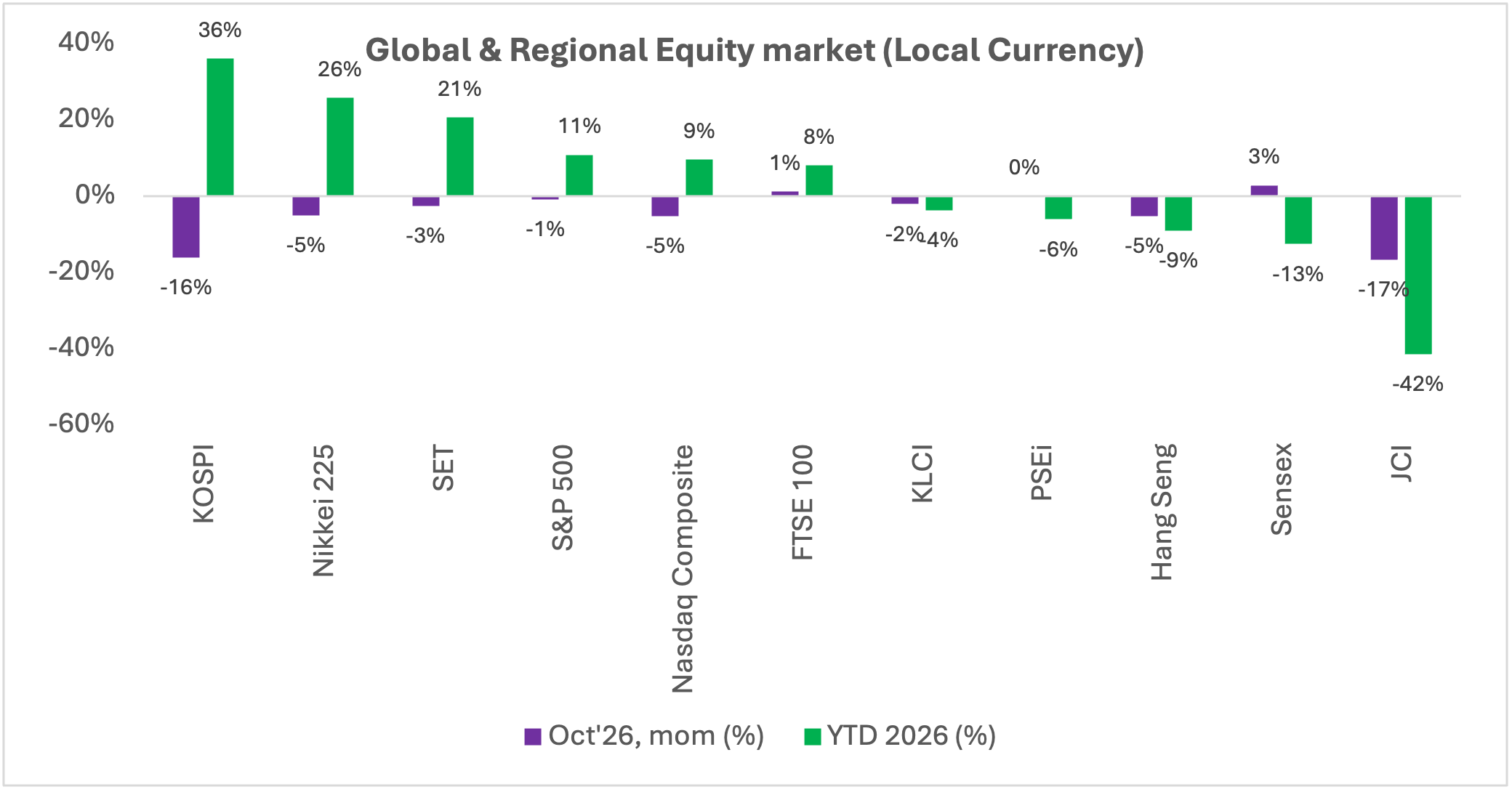
Source: Grow Investments and Bloomberg data as of 31 Oct 2026
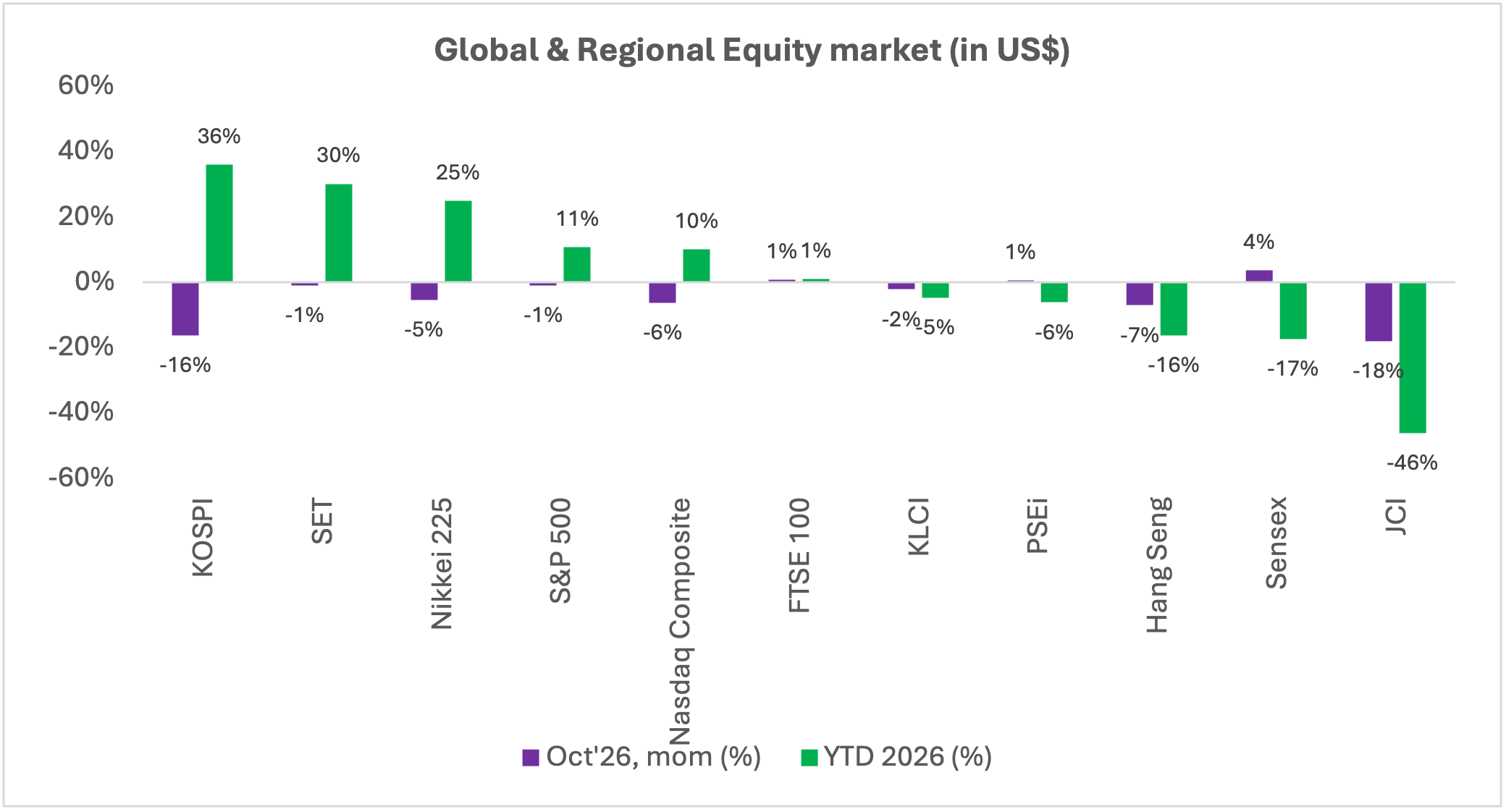
Source: Grow Investments and Bloomberg data as of 31 Oct 2026
Selling hit the broader market harder than the big-caps. All four sub-indices finished ahead of the JCI, with SRI-KEHATI down 8.3% mom, IDX30 down 13.0%, LQ45 down 14.3% and IDX80 down 16.0%. This suggests the heaviest losses came from mid and small caps and names outside the main benchmarks. Sectors offered little shelter. Among sectors with available data, Transportation & Logistics held up best, falling 13.1% mom, while Energy fell 21.7% despite higher crude prices and a 2.7% rise in Newcastle thermal coal. Industrials fell 22.9%, Basic Materials fell 23.9% as gold dropped 6.8% and LME nickel 4.1%, and Infrastructures fell 26.0%. Foreign investors recorded a net equity outflow of IDR 18.1tr, up from IDR 10.2tr in Sep'26, although trading stayed orderly, with average daily transaction value of IDR 13.1tr against IDR 13.5tr in Sep'26.
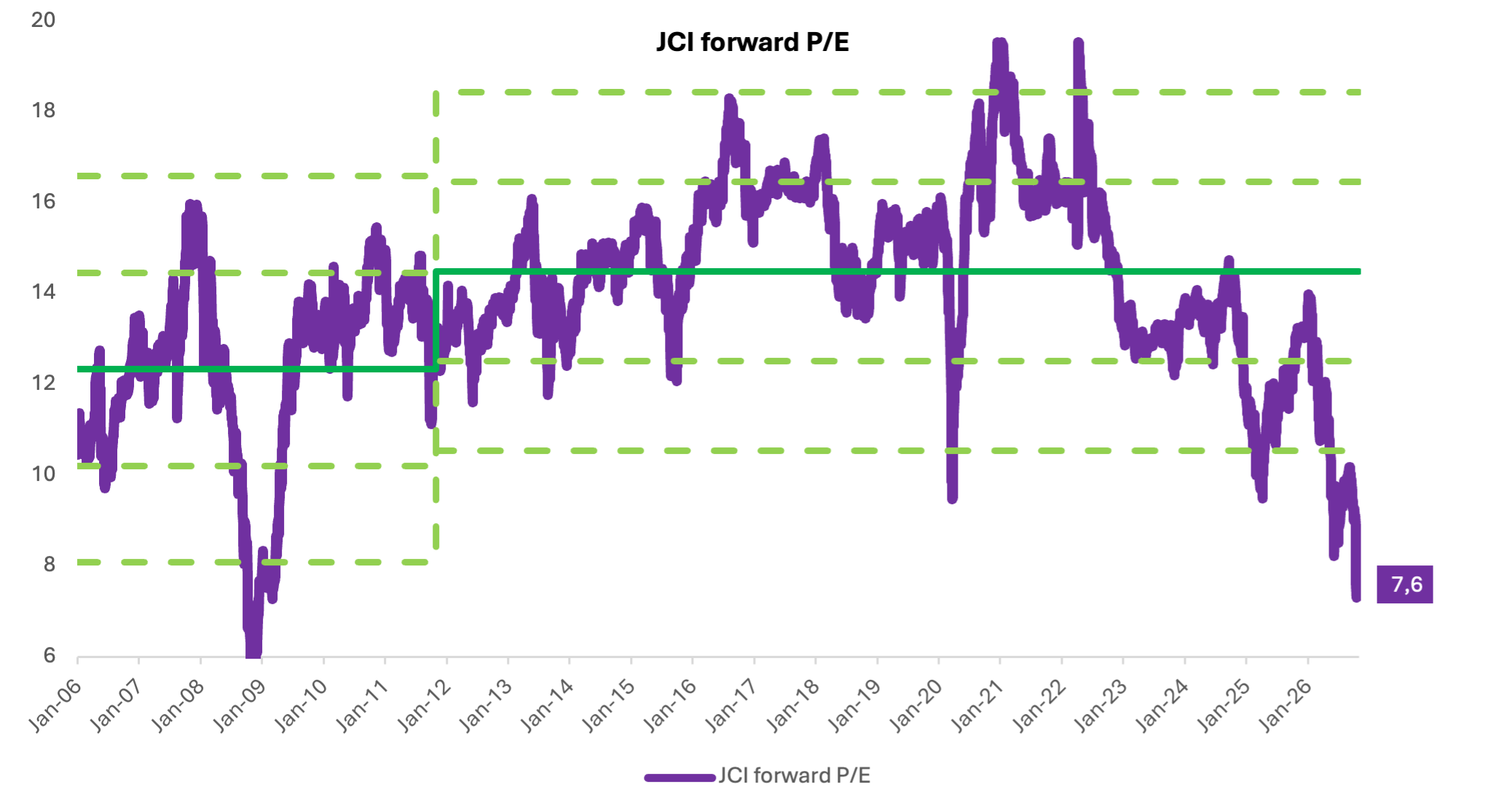
Source: Grow Investments and Bloomberg data as of 31 Oct 2026
The Indonesian government bond selloff was concentrated in the belly and long end of the curve. The INDOGB 5Y yield rose 59bps to 7.6% and the 10Y rose 58bps to 7.7%. The 30Y rose 44bps to 7.8% and the 2Y rose 24bps to 7.1%. The MSCI shock and rupiah weakness drove the move, outweighing benign inflation and BI's hold. Auction demand reflected the stress. Clearing yields at the 27 Oct'26 SUN auction were 19bps to 31bps higher than two weeks earlier, and all bids for the 90-day T-bill were rejected. BI signalled it is reducing SRBI issuance. Outstanding SRBI fell IDR 65.4tr, and awarded yields declined 16bps to 22bps across the 6M to 12M tenors. Foreign investors still added IDR 9.6tr of tradable SBN, mostly late in the month. Externally, Sep'26 FOMC minutes showed most officials saw another hike this year as likely appropriate. The Fed held at 3.75% to 4.00% on 28 Oct'26 with two dissents in favour of a hike, and futures priced a roughly 73% chance of a Dec'26 hike. The UST 10Y yield nonetheless fell 36bps to 4.9%, widening the INDOGB-UST 10Y spread by 93bps mom to 279bps.
Macro & Corporate Development
Indonesia's macro data improved through the period. Manufacturing PMI rose to 52.4 in Sep'26 and 54.0 in Oct'26. Inflation eased to 3.23% yoy in Oct'26, with core inflation moderating to 2.56%, and FX reserves rose to US$146.8bn. The trade surplus widened to US$3.6bn in Aug'26 and US$3.4bn in Sep'26, as export growth picked up to 11.9% yoy. On the other side of the ledger, imports still grew 18.4% yoy, external debt stood at US$458.9bn and retail sales grew only 1.0% yoy in Oct'26, although consumer confidence picked up to 119.9. Brent rose 13.6% mom to US$117.6/bbl and is up 93.3% YTD, which keeps the oil import bill the dominant risk to currency and rate expectations.
IDR depreciated 1.4% mom to 18,127 and is 7.9% weaker YTD, still the weakest Asian currency this year. PHP was the only regional currency to fall further, down 1.7% mom. BI raised its DNDF hedging incentives to 40% for 6M and 45% for 12M tenors, from 25% and 30%.
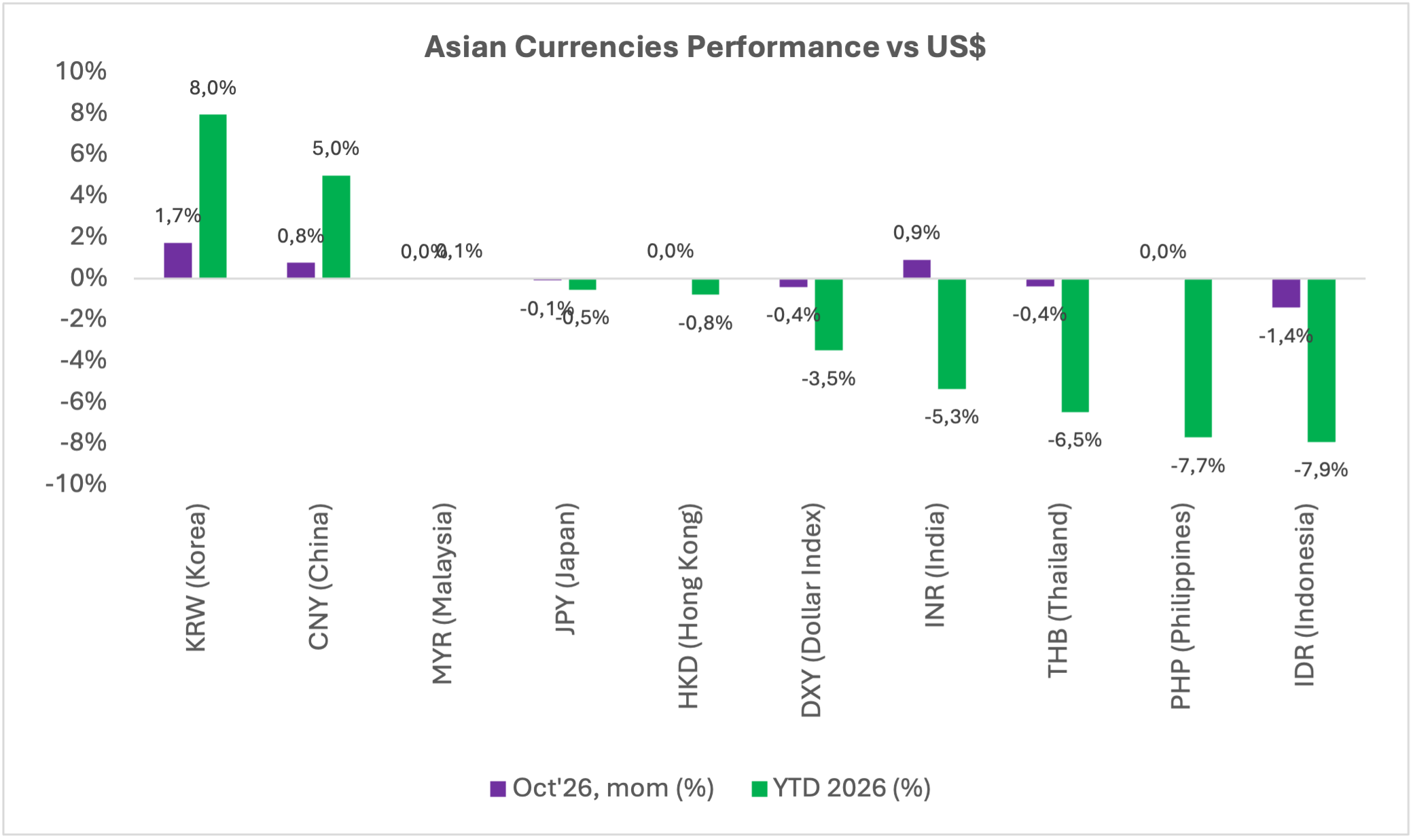
Source: Grow Investments and Bloomberg data as of 31 Oct 2026
Regulators moved quickly after the MSCI announcement. IDX lowered the single-stock auto-rejection limit to 7% and excluded high-shareholding concentration (HSC) stocks from the JCI calculation. It also further refined the methodology for its HSC list, and regulators committed to publicly disclosing the details of their market-manipulation investigations. Earlier in the month, FTSE Russell affirmed Indonesia's Emerging Market status, while Danantara, the sovereign wealth fund, stepped into domestic equities after the rout, setting aside around US$1bn for the market through end-2026. IDX shareholders also approved the exchange's first dividend and changes supporting demutualisation.
Investment Outlook
We remain cautious on Indonesian equities in Nov'26, as several events are likely to test the market's resolve. Fiscal impulse is likely to moderate in 4Q26, and growth could slow as oil prices staying above state budget assumptions limit budget room. Even so, we expect the government to step up populist policies to protect mass-market purchasing power, financed by cuts to other spending. Important legislation, particularly the Law on State Finance and the Asset Forfeiture Law, could also be introduced during the quarter and further test sentiment.
MSCI's Nov'26 review left Indonesia's Emerging Market status unchanged and maintained the freeze on index additions and upward migrations. However, the Standalone Market consultation continues until Apr'27, with a final decision expected by end-Jun'27. We expect this overhang to persist across Indonesian assets. For equities, the warning justifies a higher risk-free rate and market risk premium, so we see value mainly in depressed quality names that still offer upside after a higher cost of capital. For bonds, further uncertainty could weigh on sentiment, although INDOGB's relatively attractive valuation should cushion part of the impact.
The global backdrop for INDOGB looks more supportive this month. Democrats' control of both chambers of Congress after the US midterm elections could limit further fiscal expansion, and the UST 10Y yield has fallen below 4.9%. A weaker US$, oil back below US$100/bbl and reduced expectations of further Fed tightening point to a more favourable environment for EM debt, while lower oil prices should help contain inflation. With the INDOGB-UST 10Y spread at around 280bps, INDOGB offers a significant yield premium that could support foreign demand for carry and a gradual return of inflows. We hold a cautiously constructive view on INDOGB for Nov'26, provided global sentiment stays supportive and rupiah volatility remains contained.
Our equity sector preferences have changed. We now favour companies serving the mass-market segment, along with those generating strong cash flow and paying generous dividends. We are cautious on interest-rate sensitive sectors, highly leveraged companies, businesses catering to the middle-income segment and stocks with low free-float liquidity.