
Grow CIO Monthly Newsletter | August 2026

July 2026 marked a meaningful recovery for Indonesian financial markets amid an improving investor sentiment despite ongoing macroeconomic uncertainty. The Jakarta Composite Index (JCI) rebounded 10.5% during the month, recovering from one of the weakest first-half performances among global equity markets. The rally was supported by renewed foreign investor interest and increasingly attractive valuations following the sharp correction earlier this year. While Indonesia continues to navigate challenges—including a first trade deficit in six years, a wider fiscal deficit, rupiah weakness, and uncertainty following the unexpected resignation of the Bank Indonesia Governor—the market's resilience in July 2026 demonstrates that investors remain willing to re-engage as valuations become compelling.
Market Review
The JCI delivered one of the strongest equity market performances globally in July 2026, outperforming most ASEAN peers as well as developed markets. Foreign fund flows improved materially during the latter half of the month, supporting large-cap stocks across banking and other liquid sectors. Although the JCI remains down 27.9% year-to-date in local currency and 33.3% in U.S. dollar terms, the strong rebound in July 2026 suggests market sentiment may be stabilizing after an extended period of weakness. The additional decline in USD terms primarily reflects the continued depreciation of the rupiah, highlighting the importance of currency movements for international investors.
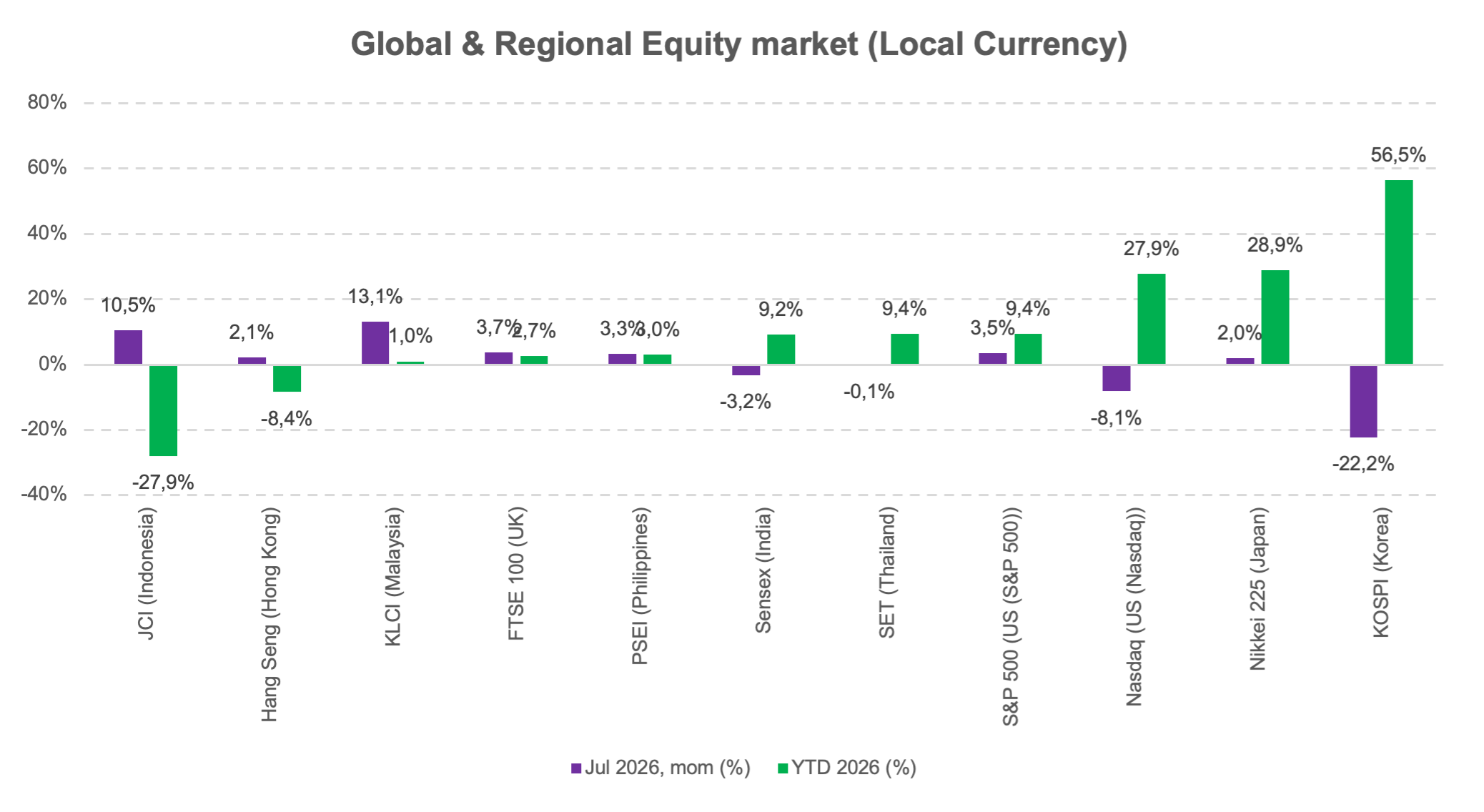
source: Bloomberg
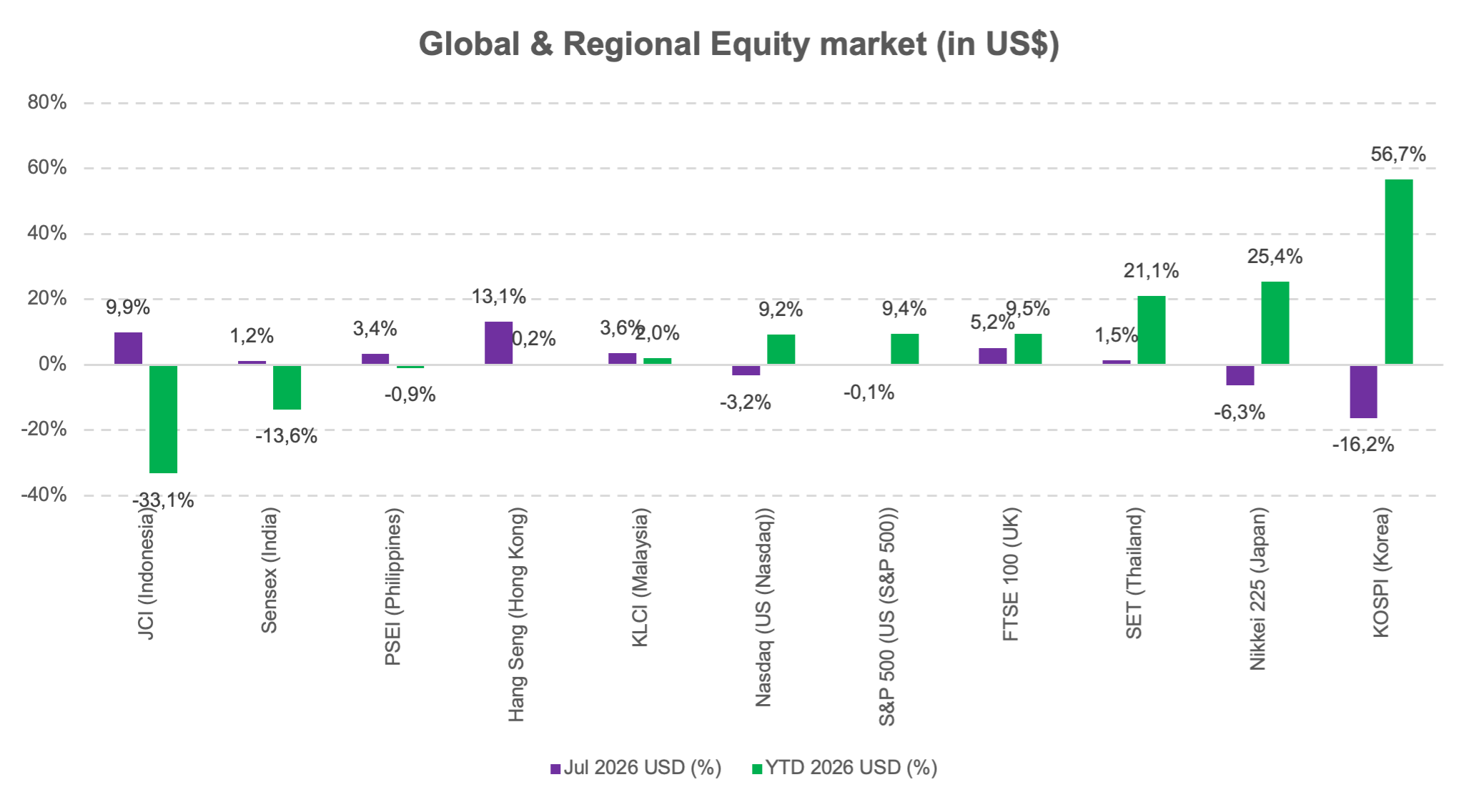
Source: Bloomberg
The recovery was led by high-quality large-cap companies. The LQ45, IDX30, and Sri Kehati indices all outperformed the broader market, reinforcing investors' preference for fundamentally strong businesses during periods of uncertainty. While some speculative small-cap stocks also posted outsized gains, leadership by quality companies provides a healthier foundation for the market's recovery.
Indonesia's fixed income market was relatively stable. Bank Indonesia maintained its benchmark interest rate at 5.75% following cumulative emergency rate hikes of 100 basis points in May and June 2026. Government bond returns were broadly flat during July 2026 as higher yields offset coupon income. Although the unexpected resignation of Governor Perry Warjiyo briefly increased volatility in both the bond and foreign exchange markets, market conditions stabilized relatively quickly, underscoring the resilience of Indonesia's financial markets.
Macro & Corporate Developments
Indonesia's macroeconomic environment continues to present both challenges and opportunities. The country recorded its first monthly trade deficit in six years, largely reflecting higher energy import costs, while the fiscal deficit widened as government expenditure continued to outpace revenue growth. Nevertheless, S&P Global Ratings reaffirmed Indonesia's BBB sovereign credit rating with a Stable Outlook, highlighting continued confidence in the country's long-term economic fundamentals despite near-term fiscal pressures.
The rupiah remains one of Asia's weaker-performing currencies in 2026, depreciating more than 7% against the U.S. dollar year-to-date. However, active intervention by Bank Indonesia has helped improve stability in recent weeks, and further normalization will likely depend on stronger external balances, credible fiscal policies, and confidence in the incoming central bank leadership.
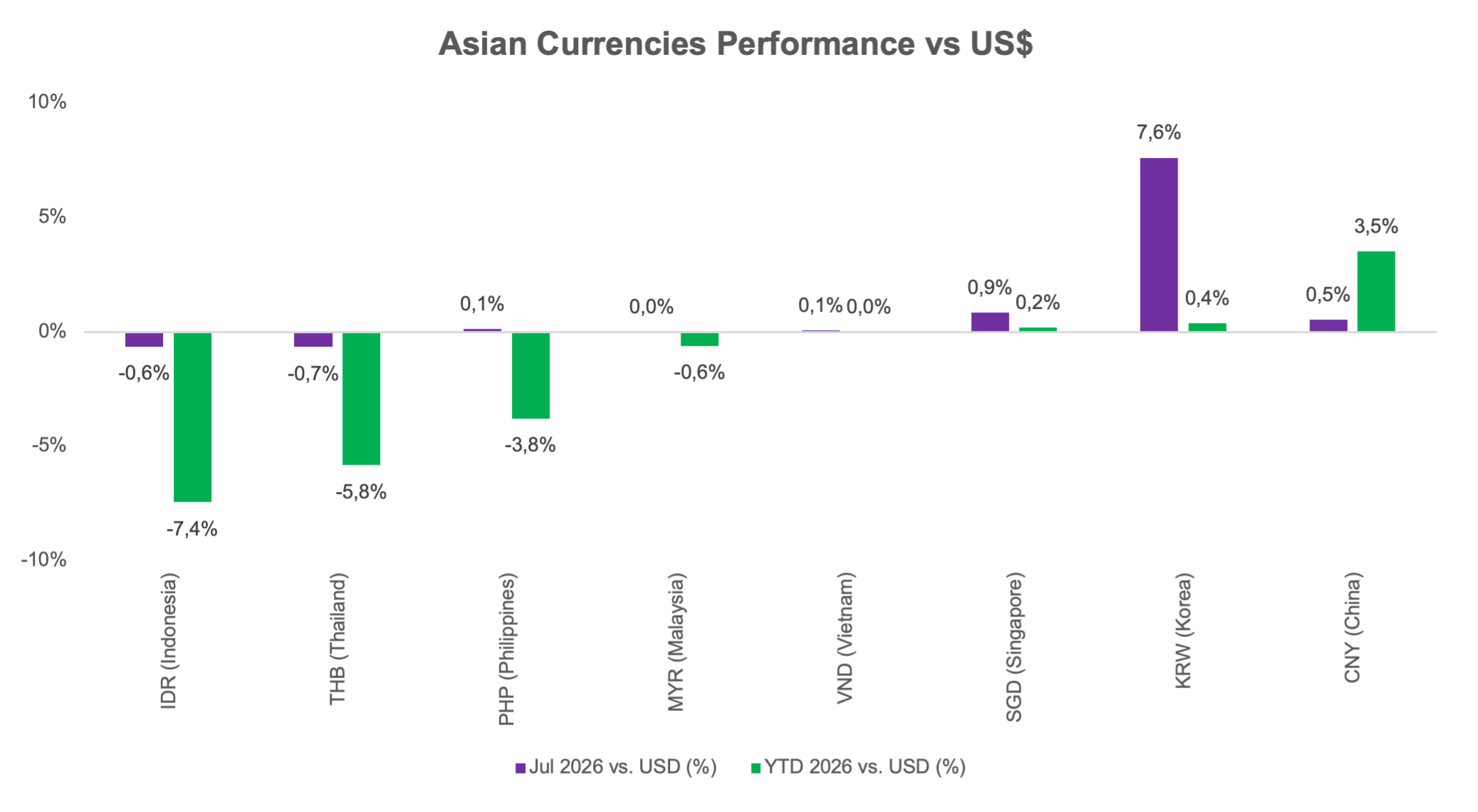
Source: Bloomberg
Corporate earnings during the first half of 2026 remained mixed but generally resilient. Banking, telecommunications, and selected consumer companies continued to deliver healthy earnings growth, supported by robust loan expansion, improving asset quality, and resilient domestic demand. Several commodity-related companies also benefited from favourable pricing dynamics. Meanwhile, mining-related conglomerates, heavy equipment companies, and several state-owned enterprises faced earnings pressure from softer commodity prices, subsidy-related costs, and rupiah depreciation. Foreign exchange losses also remained a headwind for companies with significant U.S. dollar-denominated expenses.
Investment Outlook
We remain selectively constructive heading into August 2026 as markets shift their attention toward several important domestic catalysts. Investors will closely monitor the announcement of Indonesia's 2027 State Budget, the appointment of a permanent Bank Indonesia Governor, and upcoming MSCI and FTSE index reviews, all of which could materially influence foreign investor sentiment. While elevated oil prices, rupiah weakness, and fiscal sustainability remain key risks, improving market sentiment and attractive valuations provide opportunities for long-term investors.
We maintain a constructive stance on the Indonesian government bond (INDOGB) market, although volatility is likely to remain elevated. Following the sharp repricing in bond yields over the past few months, current yield levels continue to offer attractive valuations, while Bank Indonesia's decision to keep the BI Rate unchanged at 5.75% suggests the monetary tightening cycle may be nearing its peak, provided the rupiah remains broadly stable and bond yields remain well anchored.
Easing domestic inflation and a sustained recovery in foreign inflows continue to provide a supportive backdrop for the market. Indonesian government bonds also offer one of the most attractive yield premiums among investment-grade emerging markets, reinforcing their relative attractiveness. Nevertheless, investors should continue to monitor developments in global interest rates, rupiah stability, and domestic policy developments, as these remain the key drivers of near-term market volatility. Global developments will continue to shape market performance, particularly U.S. economic data and Federal Reserve communications, as any renewed rise in U.S. Treasury yields could weigh on emerging market bonds, including Indonesia. Even so, Indonesian government bonds continue to offer an attractive risk-reward proposition, supported by relatively high real yields, improving investor sentiment, and resilient domestic demand.
Within our portfolios, we maintained a prudent level of cash to preserve flexibility while positioning for future opportunities. We continue to favour high-quality defensive companies, businesses benefiting from higher interest rates, and exporters with natural U.S. dollar revenue exposure, particularly within the energy and commodity sectors. At the same time, we remain selective toward interest-rate-sensitive companies, domestic consumption names facing margin pressures, businesses with significant U.S. dollar cost exposure, and stocks with limited free-float liquidity. With market valuations now significantly more attractive following this year's correction, we believe disciplined security selection and balanced asset allocation will enable investors to capitalize on opportunities as macroeconomic conditions gradually improve.