
Grow CIO Monthly Newsletter | October 2026

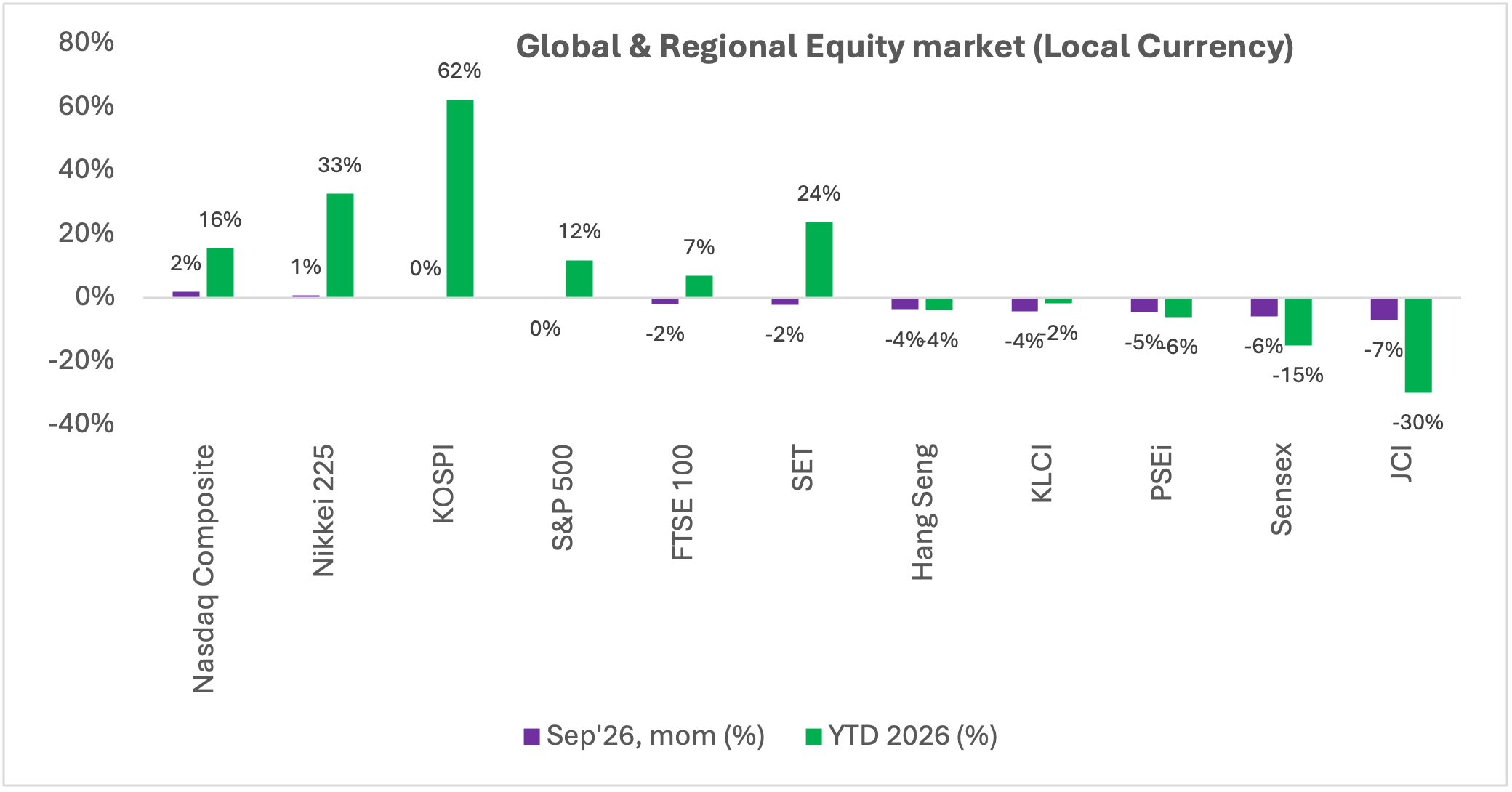
Sep'26 was a difficult month for Indonesian markets, with equities, bonds and the currency losing ground as higher US yields, a firmer US$ and rising oil prices weighed on emerging markets. The Jakarta Composite Index (JCI) fell 7.0% mom, the weakest result among the other ASEAN and developed market peers in local currency terms. Indonesian government bonds held up better, with the INDOBeX Government Total Return Index easing 0.3% mom, leaving it 0.7% lower YTD. Bank Indonesia held the BI Rate at 5.75% on 23 Sep’26, supported by Aug'26 inflation of 3.19% yoy, which remained within its target band. The appointment of a long-serving ministry official as Finance Minister, with an explicit commitment to policy continuity and budget credibility, eased some fiscal concerns. Some headwinds persist. Brent crude moved back above US$100/bbl, while faster import growth has sharply narrowed the trade surplus this year. Even so, valuations have become deeply undemanding compared to historical while BI commits to a more targeted set of tools to manage rupiah volatility. Oil prices, the Fed's policy path and the MSCI review in Nov'26 are worth monitoring.
Market Review
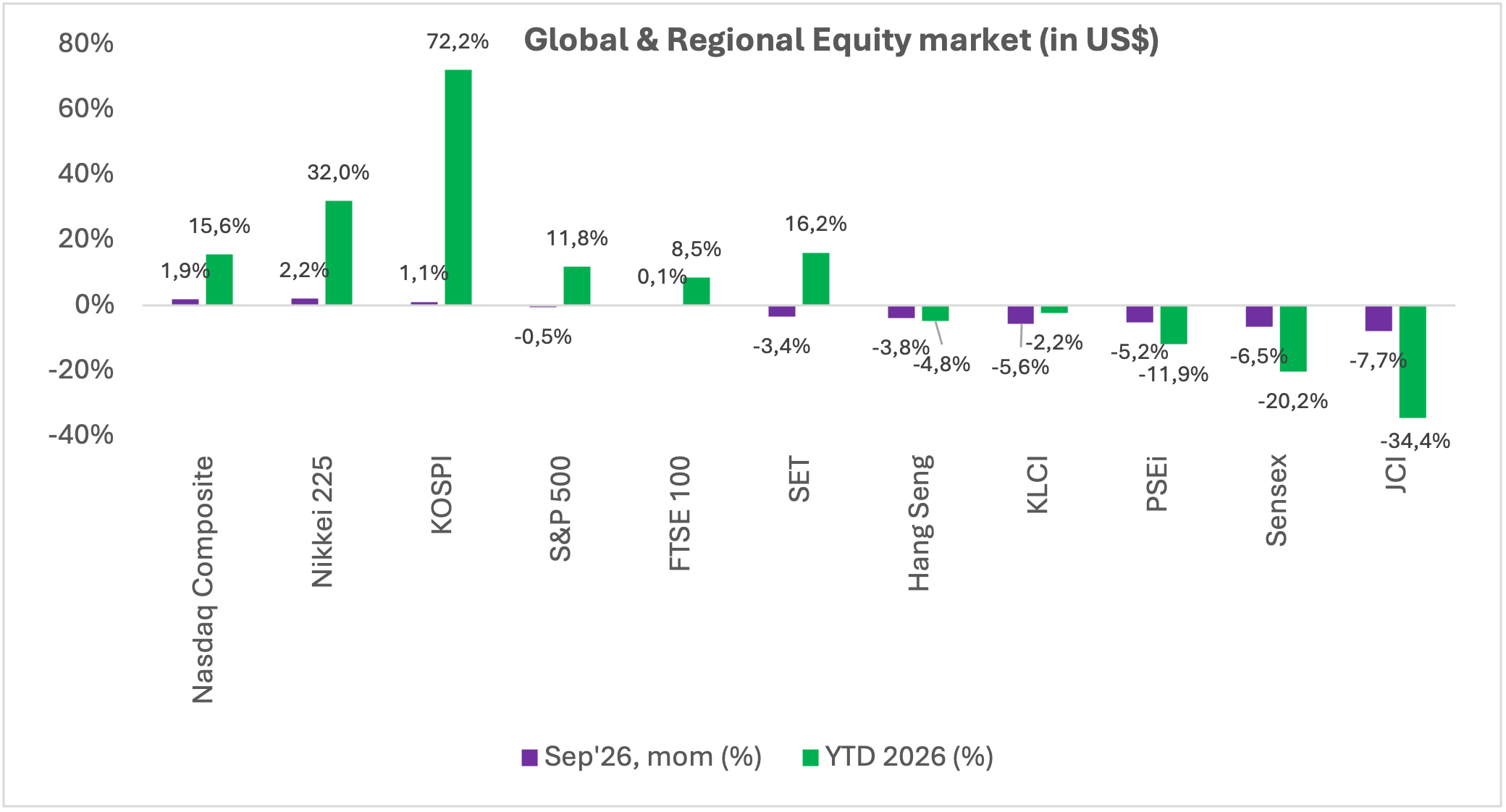
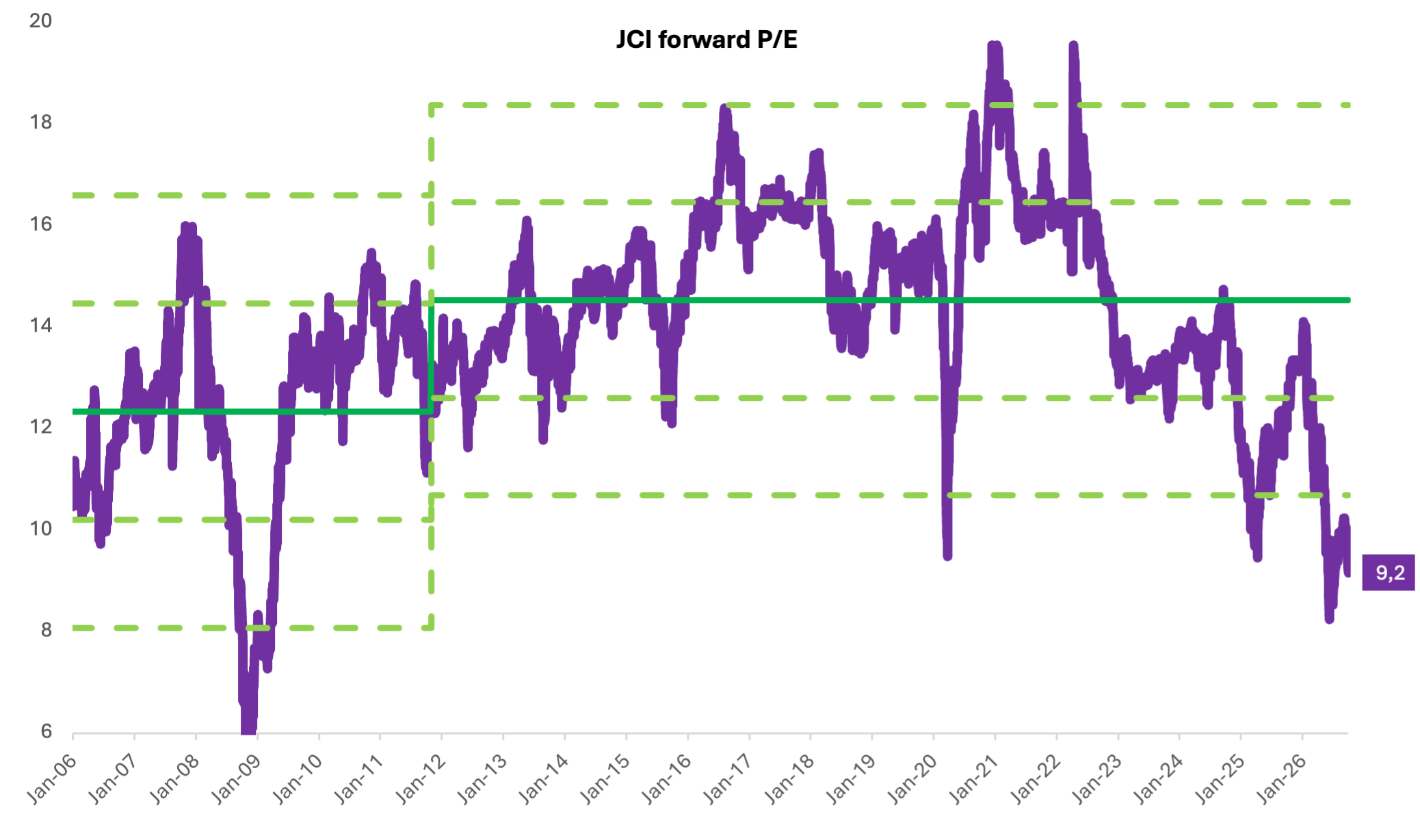
The JCI closed Sep'26 at 6,071, behind other ASEAN and developed market peers in local currency terms. A 0.8% mom depreciation in IDR turned the JCI's local loss into a 7.7% decline in US$ terms, again last in the group, while Japan led with a 2.2% gain in US$. The month adds to a difficult year. The JCI is 29.8% lower YTD in local currency and 34.4% lower in US$ terms, with the gap reflecting IDR depreciation of 6.6%. Valuations have compressed accordingly, with the index trading on 9.2x forward P/E, 2.7 standard deviations below its 12-year average.
Source: Grow Investments and Bloomberg data as of 30 Sep 2026
Source: Grow Investments and Bloomberg data as of 30 Sep 2026
Selling was broad, although the sub-indices gave a mixed signal on market-cap participation. SRI-KEHATI fell 6.3% mom and LQ45 fell 6.6%, both ahead of the JCI, while IDX80 fell 7.6% mom and IDX30 fell 7.6% mom. Industrials was the only sector to advance, rising 1.5% mom, although the gain was driven by outsized moves in a small number of lower-weight names. Transportation fell 2.5% mom, while Financials, the largest index weight, declined 5.1% mom. Energy fell 5.2% mom despite Newcastle coal gaining 3.4% mom, and Consumer Non-Cyclicals and Healthcare declined 5.4% mom and 5.8% mom, respectively. Property fell 10.5%, Infrastructure 11.0% and Technology 14.1%, with the latter affected by the removal of the minimum share-price floor. Market activity remained orderly despite the selloff: average daily transaction value was IDR 13.5tr, broadly unchanged from IDR 13.6tr in Aug'26. Foreign investors recorded a net equity outflow of IDR 10.2tr, reversing modest inflows in the previous two months.
Source: Grow Investments and Bloomberg data as of 30 Sep 2026
The Indonesian government bond selloff was broad-based across the curve. The INDOGB 2Y yield rose 3bps to 6.66%, while the 5Y yield increased 17bps to 7.00%. Further out, the 10Y and 30Y yields climbed 14bps and 15bps to 7.12% and 7.32%. Firmer Aug'26 inflation, with core inflation at its highest since Mar'23, reduced expectations of near-term easing. BI signalled that SRBI rates would be managed in line with the policy rate, after the 12M SRBI yield fell 24bps mom to 6.76%. Foreign investors bought SBN in early Sep'26 but turned net sellers late in the month, while the 29 Sep’26 auction raised IDR 28.8tr against a IDR 30tr target. Externally, the Fed raised rates by 25bps to 3.75% to 4.00% after strong payrolls and firmer core inflation. Its median projection pointed to another hike by year end, and subsequent commentary remained hawkish. The UST 10Y yield rose 54bps to 5.29%, compressing the INDOGB-UST 10Y spread by 42bps mom to 186bps.
Macro & Corporate Developments
Indonesia's macro picture was mixed. FX reserves rose to US$146.5bn, the Jul'26 trade balance returned to a small US$0.1bn surplus and consumer confidence picked up to 118.5. Loan growth remained firm at 13.7% yoy. On the other side of the ledger, Manufacturing PMI slipped back into contraction at 49.8 in Aug'26 from 50.2, while real retail sales grew only 0.5% yoy. Imports rose 27.0% yoy, leaving the Jan-Jul'26 trade surplus at US$3.7bn, well below US$23.8bn in the same period last year. Brent rose 14.4% mom and is up 70.1% YTD, making the oil import bill the dominant risk to currency and rate expectations. A parliamentary discussion on loosening the 3% fiscal deficit cap adds another policy development worth monitoring.
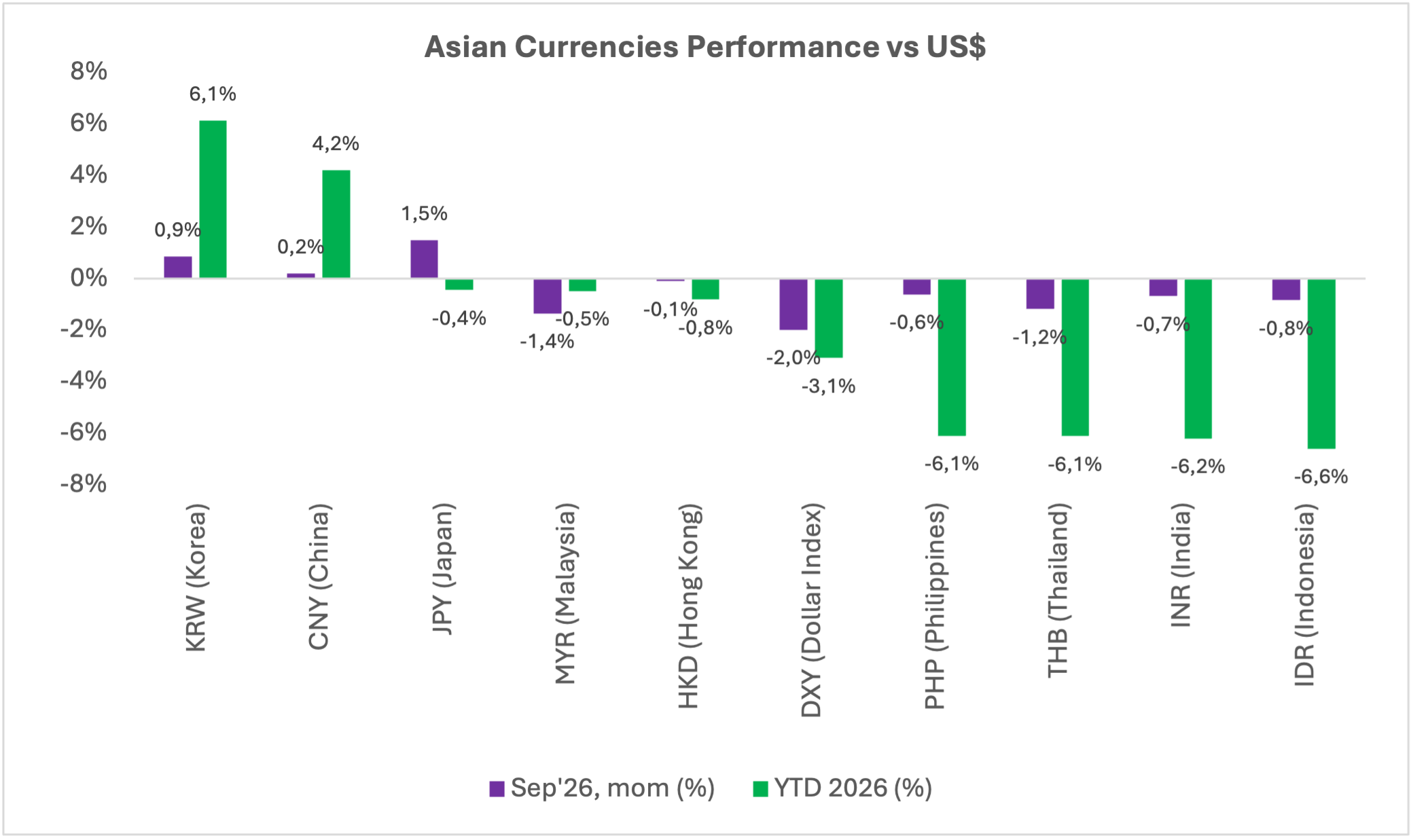
IDR depreciated 0.8% mom to 17,870 and is 6.6% weaker YTD, remaining the weakest Asian currency this year. MYR was the most notable regional decliner during the month, falling 1.4%. BI raised FX hedging incentives for portfolio inflows, foreign loans and foreign direct investment, while shifting most intervention away from the spot market to conserve reserves.
Source: Grow Investments and Bloomberg data as of 30 Sep 2026
Corporate and regulatory developments were unusually consequential. IDX removed its 50-rupiah minimum share-price floor, improving price discovery but triggering sharp declines in previously floor-bound shares. OJK also issued the framework for IDX demutualisation. In mining, new rules restricted permit holders from using affiliated contractors without government approval, although exemptions remain for strategic projects, smelters and domestic market obligations. The month's largest transaction was the acquisition of approximately 30% of Bayan Resources by another domestic mining group, reportedly valued at around US$3bn. Other activities included Ultrajaya taking over FrieslandCampina's consumer dairy operations (along with Royal FrieslandCampina acquiring 30% stake in Ultrajaya) and Siloam Hospitals' acquisition of 14 hospitals from First REIT.
Investment Outlook
Indonesian markets may continue to navigate a mixed backdrop in Oct’26. Fiscal support could moderate in 4Q26 as higher oil prices affect budget dynamics, while external factors such as a hawkish Fed and elevated UST yields remain relevant considerations for domestic asset markets. Investors are also likely to monitor ongoing policy and legislative developments that could influence the business and investment landscape.
We expect INDOGB yields to remain broadly range-bound. While domestic inflation remains manageable and BI continues to support market stability, elevated global yields, uncertainty around the Fed’s policy path and periodic rupiah volatility may limit the scope for a sustained decline in yields. With the INDOGB-UST 10Y spread below 200bps, room for further spread compression appears limited, suggesting foreign demand is likely to remain selective. In this environment, carry should continue to account for a meaningful portion of returns. A more constructive duration outlook would likely require clearer direction in UST yields, a more stable rupiah and a wider INDOGB-UST spread.
Similar considerations shape our equity outlook. Higher oil prices and a stronger US dollar support energy and commodity-related names but may also create headwinds for companies facing higher input costs. We continue to favour companies that benefit from higher interest rates, US dollar strength and the El Niño phenomenon, while remaining selective on interest-rate-sensitive sectors, businesses with significant commodity- or US dollar-linked cost exposure, and stocks with limited liquidity. The MSCI review in Nov’26 remains an important event to monitor. Our base case is for MSCI to extend its review freeze while Indonesia retains Emerging Market status, although a more meaningful improvement in sentiment would likely be supported by further progress on regulatory reforms, including greater clarity around the high-shareholding concentration (HSC) framework and ultimate beneficial ownership (UBO) disclosure requirements.