
Grow CIO Monthly Newsletter | September 2026

Aug'26 extended the recovery in Indonesian financial markets, with equities, bonds and the currency advancing together for the first time this year. The Jakarta Composite Index (JCI) gained 4.6% mom, the best result among the eleven global and regional markets we tracked in local currency terms. Indonesian government bonds also rallied strongly delivering its best monthly return of the year, with the INDOBeX Government Total Return Index gaining 2.3% mom, narrowing the YTD loss to 0.5%. Bank Indonesia held the BI Rate at 5.75% on 19 Aug’26, helped by inflation slowing to 2.88% yoy in Jul'26, while the nomination of a permanent Governor cleared an overhang that had unsettled markets since Jul'26. The macro backdrop remains supportive, although some headwinds persist. 2Q26 GDP growth moderated to 5.29% yoy and the current account deficit widened to 3.3% from 1.0% in 1Q26. Nevertheless, resilient domestic demand, improving financial market momentum and greater policy certainty provide a more constructive backdrop, with the current account and capital flows worth monitoring as the recovery gains traction.
Market Review
The JCI closed Aug'26 at 6,525, ahead of other ASEAN and developed market peers in local currency terms, finishing above Nasdaq at 3.9%, KOSPI at 3.4% and Nikkei 225 at 3.0%. Others moved the other way, with PSEi down 4.5%, SET down 1.8%, Sensex down 1.5% and Hang Seng down 1.2%. A 1.6% mom recovery in IDR converted the local gain into a 6.3% return in US$ terms, second only to Korea across the peer group. The month does not change the year-to-date position, and the JCI remains 24.5% lower YTD in local currency and 28.9% lower in US$ terms, with the gap reflecting IDR depreciation of 5.8% since 31 Dec'25. Valuations stayed undemanding, with the index trading on 10.0x forward P/E, 2.4 standard deviations below its 12-year average.
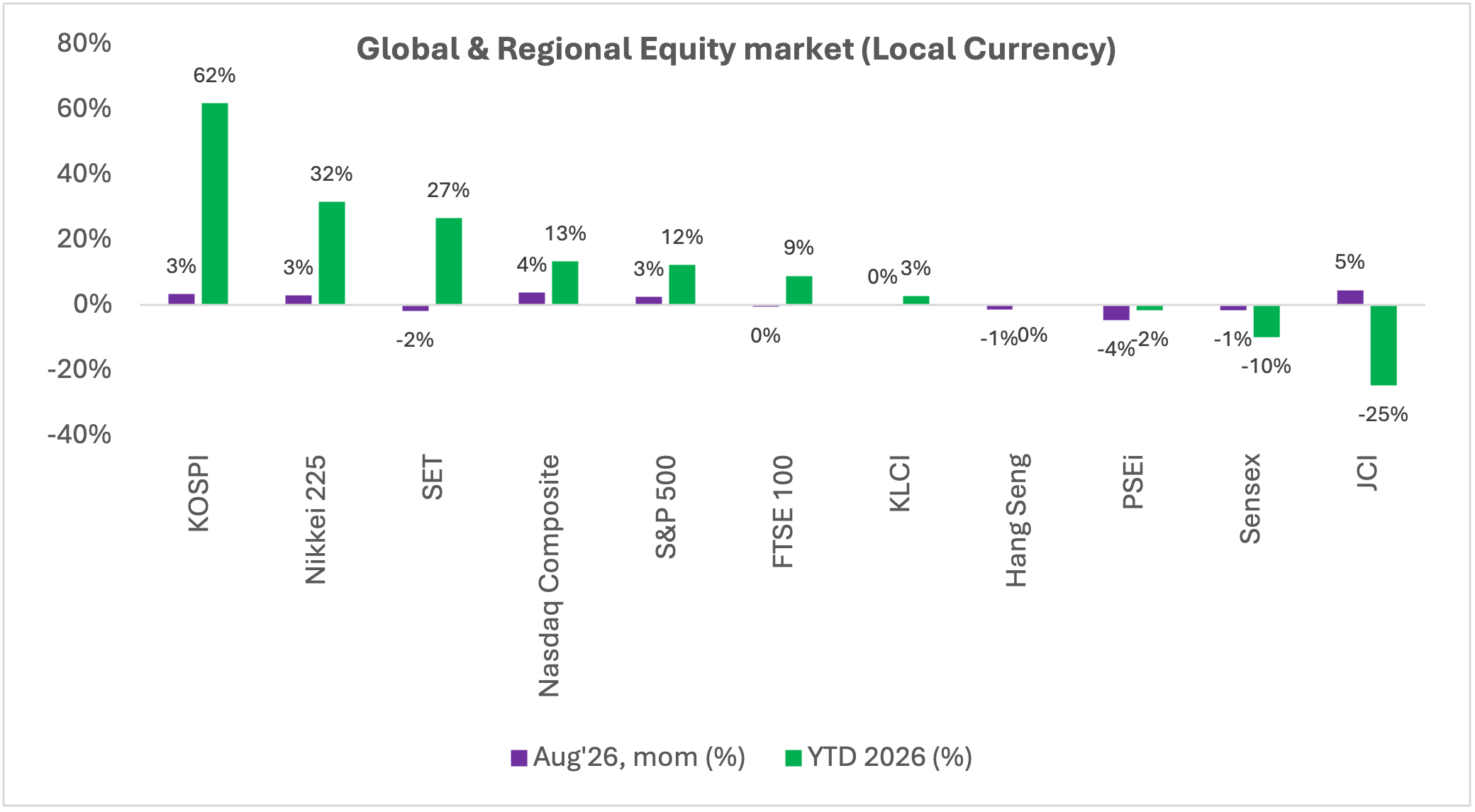
Source: Grow Investments and Bloomberg data as of 31 Aug 2026
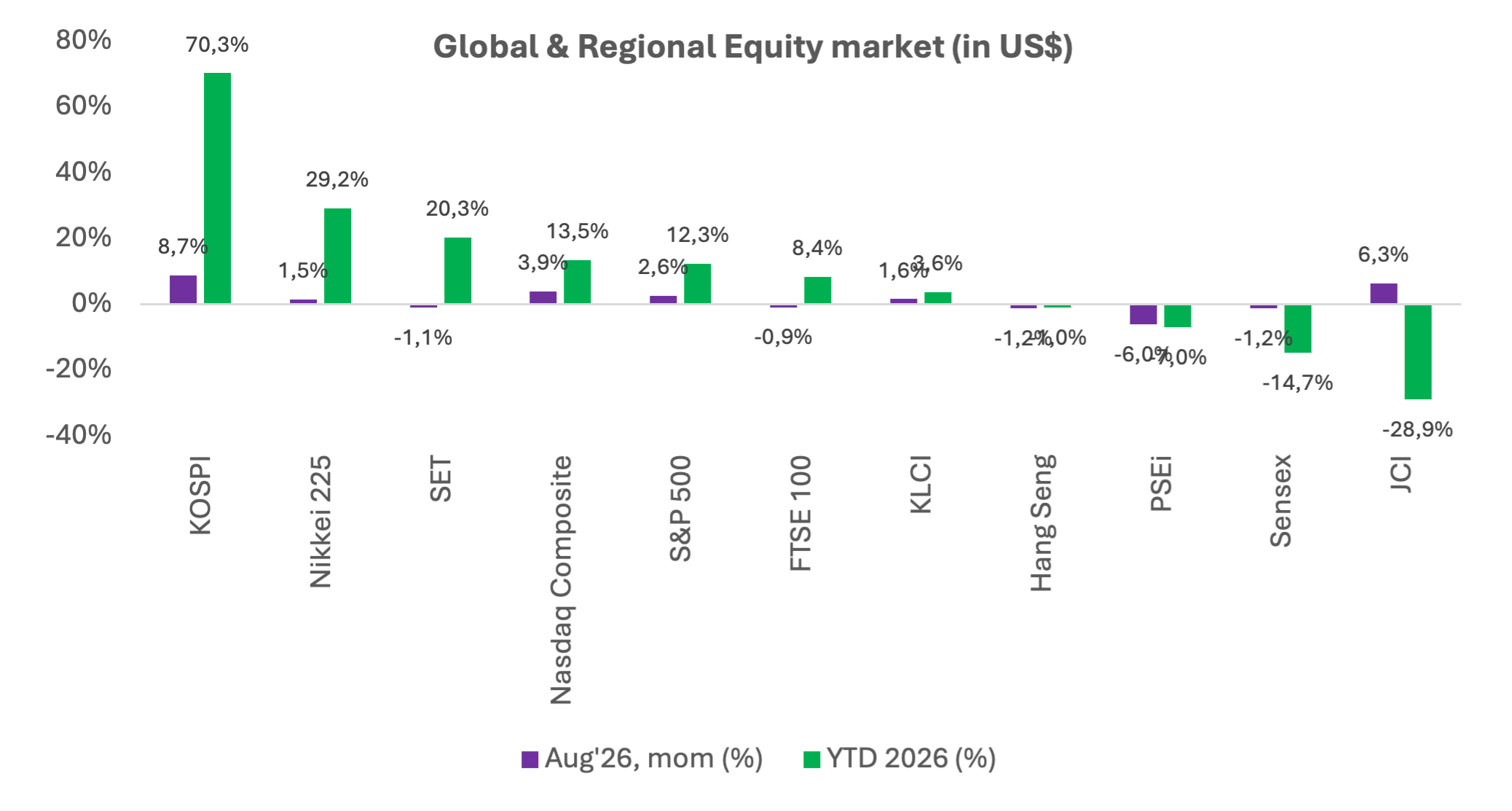
Source: Grow Investments and Bloomberg data as of 31 Aug 2026
JCI trades at an attractive 10.0x forward P/E, around 2.4 standard deviations below its 12-year average
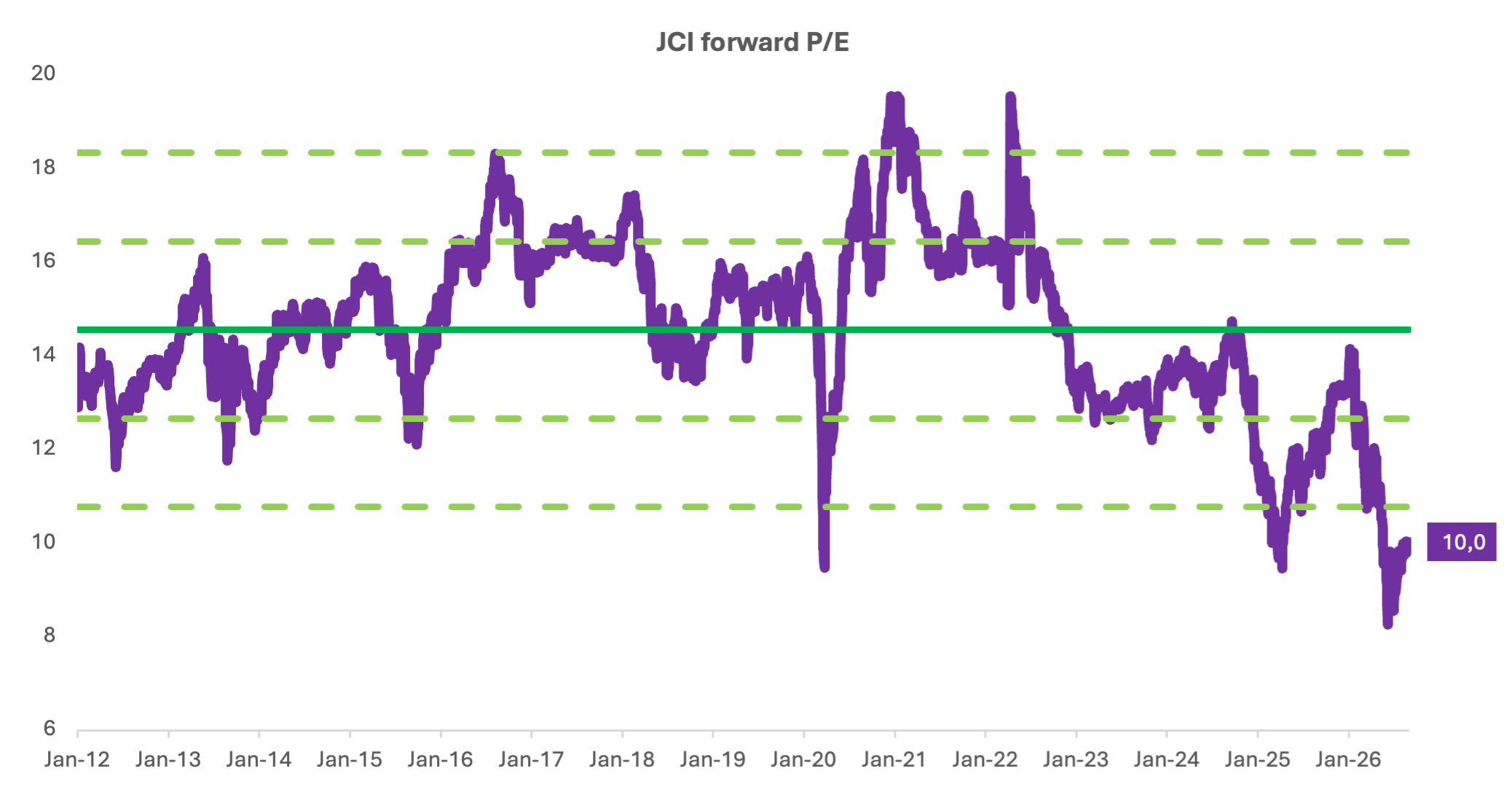
Source: Grow Investments and Bloomberg data as of 31 Aug 2026
Leadership rotated away from the big caps that drove the Jul'26 rebound. All four large cap benchmarks lagged the JCI, with IDX80 up 3.9% mom, SRI-KEHATI up 3.9%, LQ45 up 3.6% and IDX30 up 3.0%. We read this as participation broadening into mid and small caps. Sector dispersion was wide. Basic Materials led at 10.1% mom and Energy followed at 9.9%, tracking a 9.7% mom rise in gold and an 8.9% mom in Newcastle thermal coal, with CPO adding 5.4%. Transportation & Logistics, Infrastructures and Properties & Real Estate each gained more than 6%. Financials, the largest index weight, rose only 2.2%, and the heavyweight banks were the single largest drag on index points during the month. Industrials fell 0.3% and Technology fell 2.2%, the only sectors in negative territory.
The Indonesian government bond rally was strongest at the front end of the curve, with the INDOGB 5Y yield falling 44bps to 6.8%, the 2Y falling 41bps to 6.6%, the 10Y falling 34bps to 7.0% and the 30Y falling 17bps to 7.20%. Softer Jul'26 inflation, the BI hold and the Governor nomination were the primary catalysts, reinforced by BI's signal that it no longer wishes to attract flows through rising SRBI yields, with SRBI rates falling between 44bps and 63bps across the 6M to 12M tenors. Foreign investors added IDR 15.3tr of tradable SBN. FOMC minutes showed several officials had favoured a hike in Jul'26, and the Jackson Hole keynote reaffirmed inflation as the Fed's predominant focus. With UST yields broadly unchanged, the INDOGB-UST 10Y spread compressed 33bps mom to 227bps.
Macro & Corporate Developments
Indonesia's macro picture improved at the margin but remains externally exposed. Manufacturing PMI returned to expansion at 50.2 in Jul'26 from 46.9, inflation sits comfortably within target, and FX reserves held at US$145.3bn. On the other side of the ledger, 2Q26 GDP decelerated from 5.61% yoy, the current account deficit widened to US$12.5bn from US$3.6bn, external debt rose to US$453.4bn, and consumer confidence eased to 116.8. Elevated import growth alongside firm crude prices, up roughly 49% YTD, keeps the external balance the dominant risk to both currency and rate expectations.
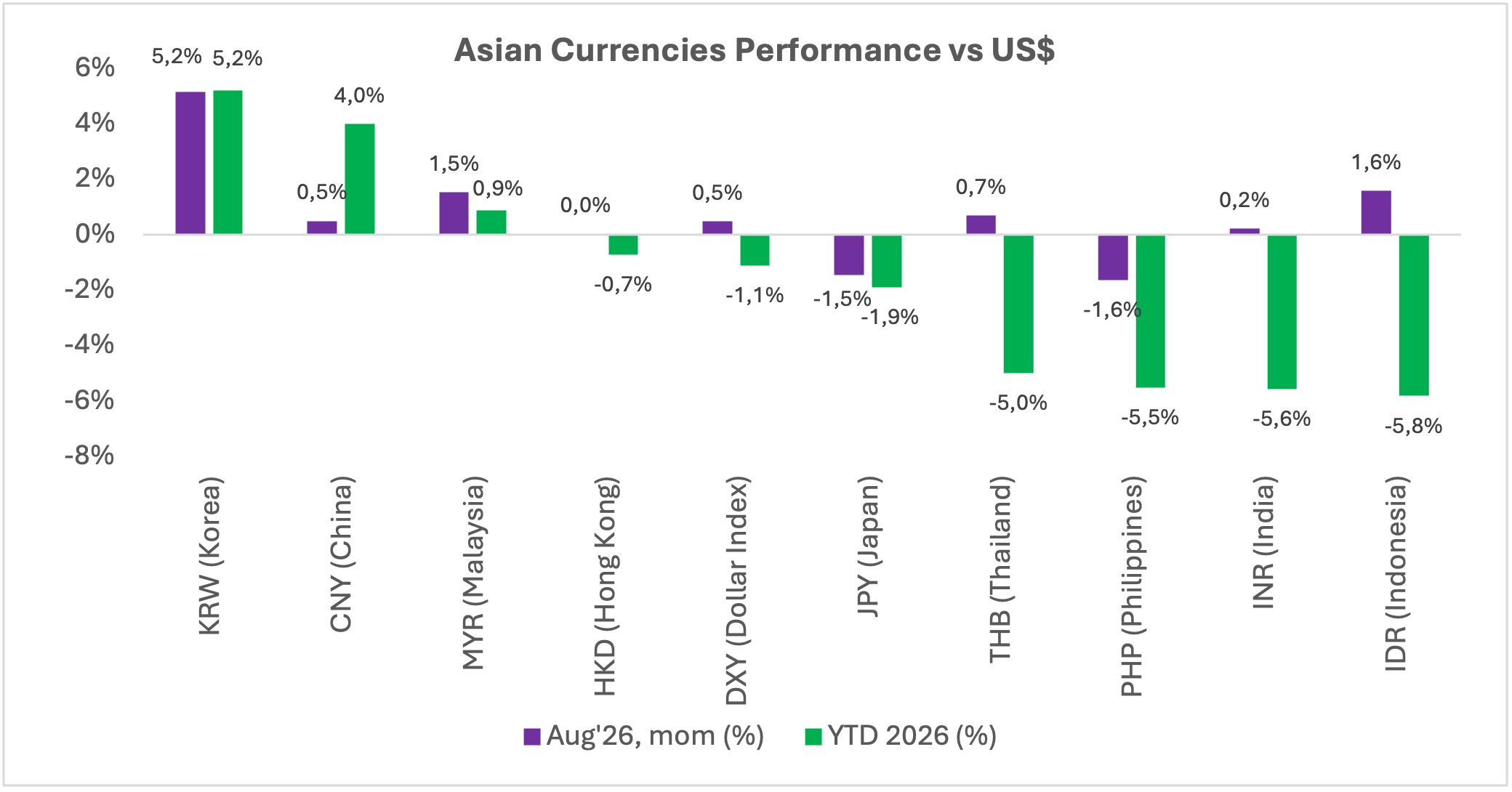
IDR appreciated 1.6% mom to 17,720, its first meaningful monthly gain this year, though it remains the weakest Asian currency YTD at negative 5.8%. PHP was the sole regional decliner at negative 1.6% mom and negative 5.5% YTD.
Investment Outlook
We are turning constructive on equities heading into Sep'26 and expect a calmer month than those behind us, as domestic policy uncertainty has receded. The FY27F budget speech pointed to a more prudent fiscal stance with moderated spending on flagship programmes, PT Danantara Sumberdaya Indonesia (“DSI”) now looks likely to retain its intermediary role rather than expand into a one-stop export agency, and Bank Indonesia has settled its leadership question by appointing a long-term technocrat. With various surveys showing the government's approval rating declining, we think the likelihood of an extreme policy shift has fallen alongside it.
Our view on Indonesian government bonds (INDOGB) remains more guarded, as global rates continue to be the key binding constraint. The UST 10Y has risen toward 5.0%, oil has moved back above US$100/bbl amid heightened geopolitical risks, while the Fed’s hawkish stance leaves limited room for a sustained EM bond rally. The market is now pricing in around 50bps of Fed hikes by year-end, compared with expectations for only one 25bps hike from BI, further widening the potential policy divergence and limiting the scope for an INDOGB rally.
Domestic conditions, however, remain relatively supportive, with resilient growth, manageable inflation, and three consecutive months of net foreign inflows providing a constructive backdrop for INDOGB. That said, IDR stability remains a key constraint and could continue to weigh on market sentiment. Two external factors could nevertheless work in INDOGB’s favour: the U.S. Treasury’s plan to double its bond buyback activity, which should improve liquidity and help absorb duration supply, and INDOGB’s attractive carry advantage over regional EM peers as investors continue to search for yield.
The shared risk across both asset classes is an escalation of the US-Iran conflict and the persistently high oil prices that would follow. On equities we also expect MSCI to extend its review freeze on Indonesia in Nov'26, with our base case that Indonesia retains Emerging Market status, and we would welcome firmer regulatory reform in the meantime, particularly greater transparency on the criteria behind the high-shareholding concentration (HSC) list and a requirement for Ultimate Benefical Owner (UBO) disclosuredisclosure. Our sector preferences are unchanged. We continue to favour companies benefiting from higher interest rates and US$ strength, principally energy and commodities, alongside those positioned to gain from the El Nino phenomenon, and we remain cautious on interest-rate sensitive sectors, on companies carrying high commodity-related and US$ input costs, and on stocks with low free-float liquidity.